
Bolton’s Bench
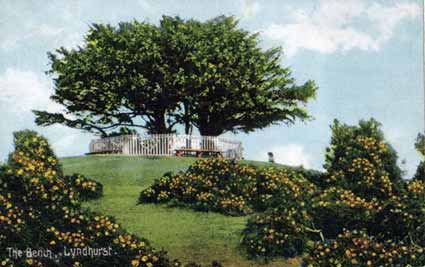
Lying to the east of Lyndhurst, not much beyond the bottom of the High Street, is Bolton’s Bench, a yew-capped hillock that is one of the village’s best known landmarks.
It is a natural knoll, and not an enormous pre-historic burial mound as is sometimes suggested. The name refers to an 18th century Duke of Bolton, Lord Warden of the New Forest, whose family were Master Keepers of Burley Bailiwick. What this Duke of Bolton did to be so immortalised is something of a mystery. Perhaps position within the New Forest community was sufficient.
Richardson, King and Driver on the late 18th century map of the area show Bolton’s Bench, although the name is barely legible, and so, too, of course, does the Ordnance Survey on its later maps.
Offering superb views back to the parish church and on up to Northerwood House, perched on the hill at Emery Down, Bolton’s Bench can be considered the gateway to the open Forest. Beyond, a wild, undulating landscape of heathland, wetland and distant woods recedes from view, haunts of Dartford warblers, woodlarks, silver-studded blue butterflies, fallow and roe deer, and a host of other creatures.
Cricket is still played on a pitch adjoining Bolton’s Bench, just as it has been since the first half of the 19th century, providing a most ‘New Forest’ of scenes - ponies, donkeys and cattle wander the outfields whilst cricketers try to concentrate on their game.
The wide open spaces of the hill are favoured by people intent on enjoying the view and mingling with the stock, and also by kite-flying enthusiasts, whilst on the few recent occasions when snow has covered the ground, children have arrived in large numbers to enjoy tobogganing down the slopes.
Nearby is the Lyndhurst Park Hotel, an impressively large, white-fronted building facing on to the Ashurst road. Built in the first half of the 19th century as a private residence, it was known as Glasshayes and shows as such on the 1870s and 1898 Ordnance Survey maps. By 1909, however, it is shown as the Grand Hotel – the change apparently occurred very late in the 19th century.
References:
Lyndhurst Historical Society publications: Roy Jackman
Lyndhurst – A Brief History and Guide: Georgina Babey and Peter Roberts
More links
Other related links
Search this site
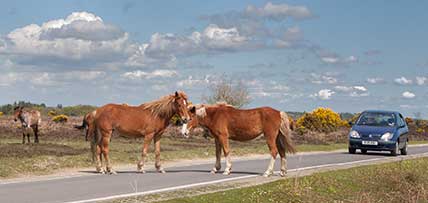
Sadly, 58 animals were killed - 35 ponies, 13 cows, 8 donkeys and 2 sheep, whilst a further 32 were injured - 3 pigs, 9 donkeys, 11 cows and 9 ponies.
(Forty-three accidents occurred in daylight, 15 at twilight and 101 in the dark. Twenty-seven accidents were not reported by the driver involved).
Here's just one horrific example - Three donkeys killed in collision with van at notorious New Forest blackspot (Advertiser and Times)